
Turning a Proven Client Attraction Methodology into an AI Business Assistant
How we helped Double Your Business turn its coaching methodology into a practical AI platform that helps entrepreneurs apply it to their own businesses.
LIVE PRODUCT
Used by Double Your Business clients and community
10 SPECIALISED MODULES
From ideal client and positioning to sales and marketing content
AI + EXPERT METHODOLOGY
Purpose-built reasoning and behaviour architecture
The client and the challenge
Double Your Business works with small-business owners on client attraction, marketing, sales and business growth.
Its founder, business consultant and author Alexander Nikolov, has spent more than a decade developing and applying his own methods through coaching programmes, workshops, books and practical tools.
A central part of this work is his Client Attraction methodology. It addresses practical questions small-business owners regularly face: Who is the right client for my business? How should I position what I offer? Where can I reach potential customers? How do I structure an attractive offer? How do I turn interest into a sale?
Double Your Business came to us with an idea: could this expertise become an AI product that clients could work with directly?
The challenge was not simply to put Alexander’s books into a knowledge base and add a chat interface. We needed to understand how the methodology is applied in practice and translate enough of that logic — together with elements of Alexander’s coaching approach — into a product that could work with very different businesses.
What we built
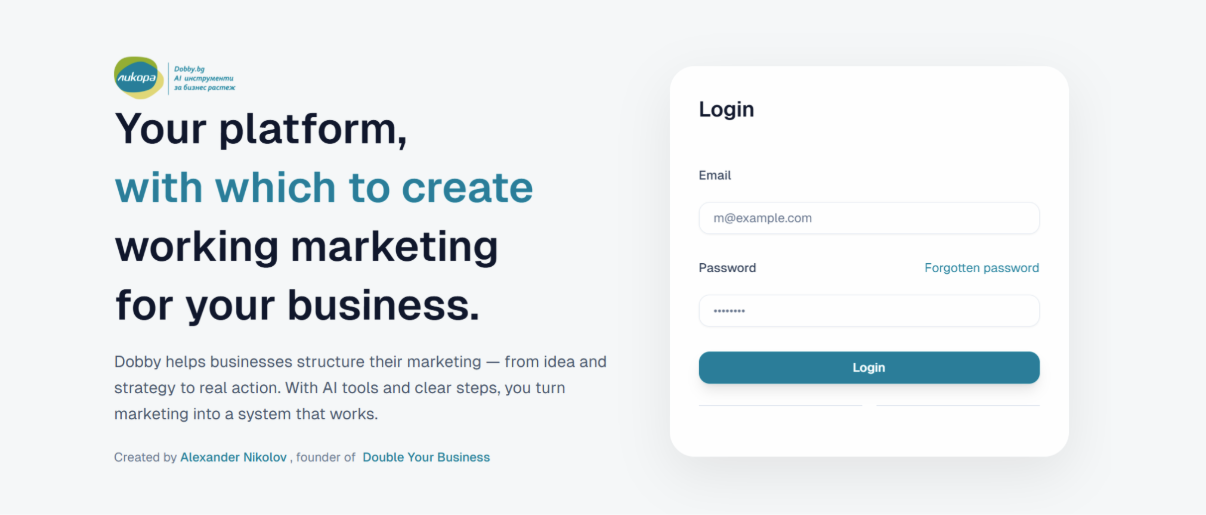
Extreme Consulting designed and developed Dobby, an AI business assistant now available to Double Your Business clients and community.
At the centre of the platform are 10 specialised business modules that cover different parts of the client-attraction process — from defining an ideal client and identifying where to reach them to developing offers, preparing sales conversations, creating presentations, and producing marketing content.
Each module is designed around a specific business task rather than exposing the user to a generic AI prompt.
The platform uses information about the user’s business, combines it with the relevant parts of Alexander’s methodology, and uses purpose-built AI instructions to produce a structured, practical result.
Users can maintain up to three separate businesses within the same account, each with its own context.
Dobby also includes a broader Business Advisor capability for questions outside the structured modules, drawing on additional books and materials covering Alexander’s wider thinking on business growth, mindset, focus and planning.
How it works in practice
A business owner might start by using Dobby to clarify who their ideal client really is. That understanding can later become useful context when the same user works on positioning, marketing messages or an offer.
Another user may develop a lead magnet and continue with the related landing page and follow-up communication. Someone else might use Dobby to prepare a sales conversation, develop an offer or structure a presentation.
The important part is that these are not isolated AI requests. Relevant business information can be reused as the user works on different parts of client attraction, rather than requiring them to explain the company again every time.
For customer-facing content, we added another layer of personalisation.
When Dobby creates an article, social media post, landing page, or video script, users can define how they want their business to communicate — including tone, preferred terminology, and phrases they want to use or avoid.
This allows Alexander’s methodology to influence the thinking and structure behind the content without making every business sound like Alexander — or like the same AI assistant.
Designing how the AI works
One of the most substantial parts of Dobby wasn't giving AI access to Alexander’s knowledge. It was designing how a general-purpose language model should behave when applying that knowledge.
We built a layered instruction architecture around the model.
At the foundation is Alexander’s knowledge — his books, methodologies, examples and supporting materials. A behavioural layer defines the principles Dobby should consistently follow: how to approach business problems, what to prioritise, how to challenge vague assumptions, and when to reject generic marketing advice in favour of Alexander’s methodology.
Each module then adds its own task-specific logic.
It defines its purpose, the information it needs, its boundaries and expected result, but also how the AI should interpret and transform the information before producing that result.
Different modules therefore require different AI behaviour. Identifying an ideal client may involve analysing several possible directions and helping the user decide. Developing a client profile requires interpreting and systematising information. A landing page or content module takes established strategic context and transforms it into a finished communication asset.
The model is not simply given a different question each time. The reasoning pattern changes according to the task.
We also built quality and scope controls into the system to reduce vague or generic outputs, keep the AI within the active module's responsibilities, and prevent external knowledge from overriding the core methodology.
This allows the underlying LLM to remain flexible while its behaviour is deliberately shaped around a particular expert’s methodology and way of working.
The books give Dobby knowledge. The behavioural and module architecture teaches it how to apply that knowledge — what to look for, how to reason with it and how to turn it into a specific business outcome.
Building the product behind the conversation
Although the user experience is deliberately simple and conversational, Dobby was built as a full web application rather than a thin interface over an AI model.
The platform combines the specialised modules, persistent business context and a knowledge layer containing Alexander’s books and supporting materials.
Payload CMS with MongoDB provides the main backend foundation. In addition to application data, it supports the administrative environment, Resource Library and parts of the AI configuration. This allows the Double Your Business team to maintain knowledge resources and continue refining the AI experience without requiring application changes every time.
The AI layer uses the OpenAI API with vector-based knowledge retrieval, while the individual modules determine how to apply relevant knowledge and business context to each task.
Most of this complexity remains invisible to the user. They simply work with Dobby through the conversational interface.
The outcome
Dobby is live and being used by Double Your Business clients and community.
For many small-business owners, the difficult part comes after a course or coaching session: turning a principle into something specific they can actually use in their business.
Dobby helps close that gap. Clients can apply Alexander’s methodology to their own situation and develop practical outputs such as client profiles, offers, sales conversations, landing pages, presentations and marketing content — without starting from a blank page or having to become skilled at prompting AI.
For Double Your Business, Dobby extends Alexander’s coaching beyond the time he can personally spend with each client. It gives clients an additional way to work with his methodology when they need it, while complementing rather than replacing the coaching relationship.
The result is a shorter distance between “I understand what I should do” and “I have something I can actually use in my business.”
Client perspective
Suggested wording for Alexander to review and adapt:
“What was important to me was not simply giving an AI access to my books. I wanted Dobby to work with clients in a way that reflects how I approach business problems — to use the methodology, understand their specific situation and help them create something practical. I think we managed to achieve that.”
- Alexander Nikolov, Founder, Double Your Business
What this project demonstrates
Dobby is one example of a broader opportunity for organisations that already own valuable expertise.
That expertise may exist as a consulting methodology, training programme, professional framework, internal playbook or specialist process developed over many years.
Giving an AI model access to those documents is becoming relatively straightforward.
The more interesting work starts afterwards: How should the AI apply that expertise? What context does it need from the user? How should different tasks be approached? What should remain consistent? Where should the AI adapt? What should a useful result actually look like?
That was a significant part of the work behind Dobby.
The result is not simply a chatbot that knows Alexander’s books. It is a working example of how proprietary knowledge and ways of working can be translated into an AI-enabled product that clients can use in their own context.
For organisations with established expertise, the opportunity may not be another chatbot, but a new way for clients, employees or partners to interact with and apply that expertise.
Technology Stack
Next.js · React · TypeScript · Payload CMS · MongoDB · OpenAI API · Vector-based Knowledge Retrieval · AWS
